
Fragile Stickers and why they are not effective
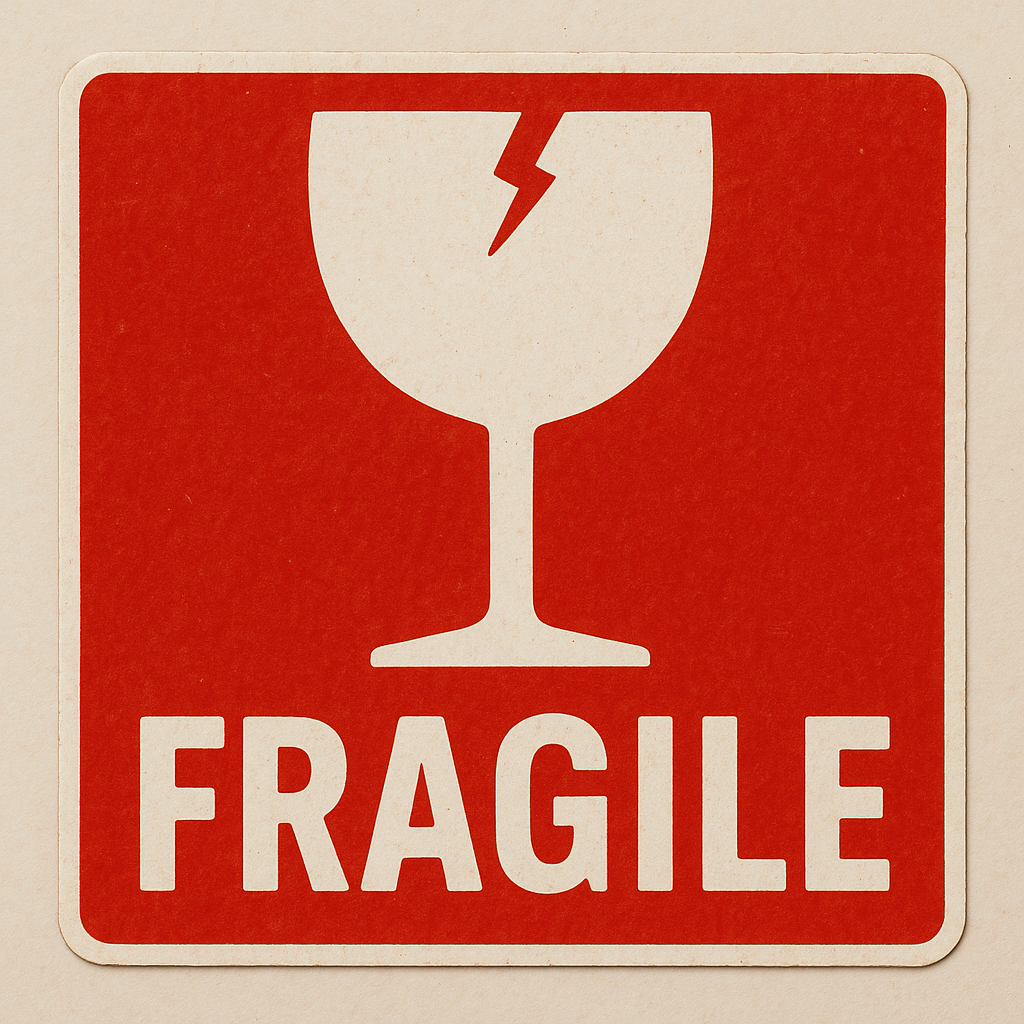
You’ve probably done it: packed a delicate product, slapped a giant red “Fragile” sticker on the box/bag, and thought it would be handled with extra care.
The truth?
In the real world, “Fragile” stickers almost never do what you think they should do.
They do not meaningfully change how carriers handle your package, they don’t change the physics of drops and impacts, and they absolutely do not reduce damage rates on their own. At best they are a polite suggestion. At worst, they create a false sense of security that leads to weaker packaging and more damage.
This post breaks down why “fragile” stickers don’t work, and what actually does protect your products.
Carrier systems are not built around your sticker
Shipping networks are built for speed, throughput, and consistency. Not special care for individual parcels.
Automation runs the show
Parcels move on conveyors, chutes, slides, and through automated sortation systems. These machines frankly don’t care that your package reads “Fragile” ; they treat every parcel the same way at the same speed.
Standard handling is already brutal
Carriers assume that every package might be dropped, tossed, slid, or stacked. Their system is grounded on the idea that your packaging must survive this.
2. A sticker unfortunately cannot change physics
Your package is still going to experience:
Drops
Impact and vibration
Compression and stacking
A “fragile” label does not reduce any of those forces.
Only packaging design controls what the product feels
3. Human Behavior
Label fatigue is real
Think, if you saw the same sticker day by day you would probably become numb to seeing it.
Fragile is so vague
What does it actually mean?
Don't stack?
Don't tilt?
Keep upright?
Without clear instructions, it is up to interpretation
Language gaps
Fragile might work in the States, but what happens if it travels to a different country? People won’t know what it means.
Even when people see your sticker, there is weak motivation and no clear, shared definition of what to do about it.
4. Fragile labels are not a formal standard.
Some labels carry lots of weight: Hazardous materials, temperature control, biohazard, etc. “Fragile is not one of them.
Carriers put responsibility on the shipper
Standard carrier terms say you are responsible for packaging goods so they can withstand normal handling.
No mandated SOPs
Hamzat and certain medical shipments have formal handling protocols. A “fragile” sticker does not.
Bottom line: Operationally and legally, “fragile” is decoration not a standard.
5. It can backfire and negatively affect your brand image.
False sense of security
You may be inclined to cut corners and reduce packaging because you trusted the label. This leads to high damage rates
Customer expectations
Imagine the package has a “fragile” sticker on it and the product shows up damaged. First, that hurts your brand reputation, and second you now have to refund and/or replace. Both are costly options.
Takeaway: Stickers often raise expectations without increasing protection
What actually works:
The most reliable mindset is:
Design packaging as if nobody will ever read your labels
Because it is true
Here is a checklist:
Assume drops, vibrations, and stacking will happen
Use cushioning and structural design to absorb real world forces:
Adequate cushioning thickness and material selection
Blocking and bracing to prevent movement
Strong enough out carton (Right board grade, construction, and size)
Double boxing or suspension packaging for fragile items (Called overpacking)
Test against realistic shipping conditions (ASTM4169 or ISTA 3A is a great starting point).
Here is a high level summary:
“Fragile” stickers mostly fail because:
They do not change the processes of carriers
They do not change physics
They have little effect on human behavior
They can backfire
Real protection comes from engineering the packaging, not from asking the world to be gentle.
Stop gambling on “FRAGILE” stickers and start shipping with confidence. 👉 Book a quick consult today, and I’ll audit your current packaging, show you exactly where you’re exposed, and build a protection strategy that actually cuts damage rates and saves you money.
