Packaging Strategy for an Aluminum Coaster Set
Project Overview
A premium aluminum coaster set needed a packaging system that could protect the product during parcel distribution while supporting a quality customer experience and keeping launch costs under control.
Rather than immediately committing to custom packaging and high minimum-order quantities, the project evaluated multiple packaging concepts across a range of cost, protection, presentation, and scalability requirements.
Product Characteristics
Durable aluminum construction
Cork backing
Rounded edges with no exposed sharp surfaces
Approximately 3.925" diameter
Approximately 3.375" side-to-side dimension
Multiple components packaged together as a set
The Challenge
The packaging needed to balance several competing priorities:
Product Protection
Individual coasters needed to remain restrained during shipment to reduce movement, scuffing, and surface-to-surface contact.
Package Integrity
The package needed to remain securely closed throughout parcel distribution while minimizing the possibility of components becoming separated or lost.
Customer Experience
Because the product had a premium appearance, packaging presentation and unboxing experience were important considerations.
Launch Economics
Demand had not yet been fully established, making large investments in custom inserts, tooling, and high minimum-order quantities difficult to justify.
Engineering Approach
Four packaging concepts were developed and compared from premium to value-focused configurations.
Each concept was considered against:
Estimated packaging cost
Product restraint
Protection during parcel distribution
Customer presentation
Packaging complexity
Ease of packing
Minimum-order requirements
Scalability as product demand increased
Concept 1 — Premium Packaging System
Estimated packaging cost: $7–$8 per set
Each coaster would be retained in a dedicated custom insert inside a roll-tuck presentation box. The presentation package would then be placed inside a separate corrugated shipping container.
Advantages
Highest level of product restraint
Strongest premium presentation
Added protection from the secondary shipping container
Controlled component placement during unboxing
Tradeoffs
Highest packaging cost
Custom insert requires additional development and minimum-order quantities
More packaging components and packing steps
Best suited for: A mature product where premium presentation and protection justify the additional packaging investment.
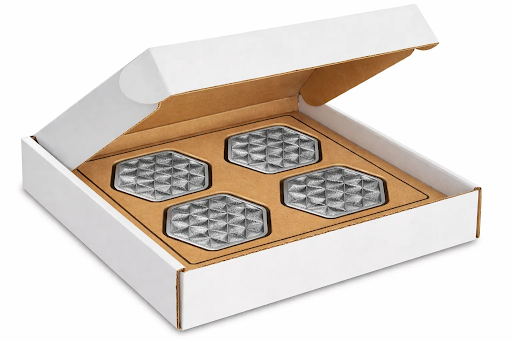
Concept 2 — Premium Single-Package Solution
Estimated packaging cost: approximately $5.50 per set
Each coaster would be retained in a custom insert inside a roll-tuck corrugated mailer that functions as both the sales package and shipping package.
Advantages
Premium presentation
Dedicated product restraint
Fewer components than the premium overpack configuration
Simplified pack-out
Tradeoffs
Less distribution redundancy than a separate shipping overpack
Higher packaging investment than simpler alternatives
Custom insert remains dependent on volume and MOQ
Best suited for: A product requiring strong presentation while limiting the number of packaging components.
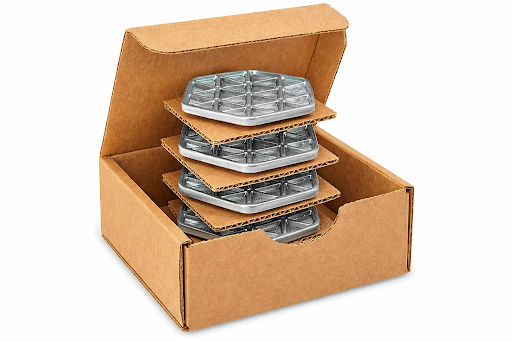
Concept 3 — Balanced Cost and Experience
Estimated packaging cost: approximately $1.65 per set
The coasters would be stacked within a roll-tuck corrugated mailer with corrugated separator sheets placed between components to reduce direct surface contact.
Advantages
Significant reduction in packaging cost
Better presentation than flexible mailer packaging
Simple construction and pack-out
Adaptable to future product shapes or variations
Lower dependence on highly customized components
Tradeoffs
Less individual product restraint than a custom insert
Presentation is more functional than premium
Best suited for: A growing product where cost, protection, presentation, and flexibility need to remain balanced.
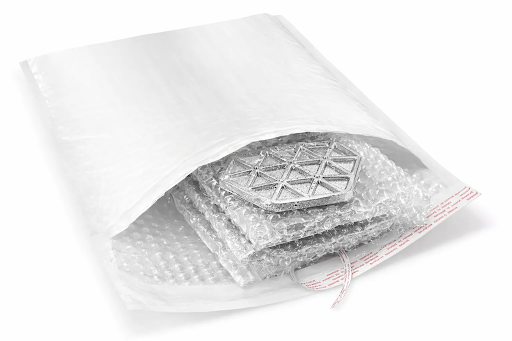
Concept 4 — Minimum Viable Packaging
Estimated packaging cost: approximately $0.74 per set
The coaster set would be wrapped with protective bubble material and placed inside a padded poly mailer.
Advantages
Lowest initial packaging cost
Minimal development time
Low barrier to launch
Easy to source and implement
Avoids early investment in custom packaging
Tradeoffs
Limited premium presentation
Packing consistency becomes more important
Greater potential for cosmetic movement or variation in protection
Less control over the customer unboxing experience
Best suited for: Initial product validation and low-volume launch.
Recommendation
The recommended launch strategy was to begin with the minimum viable packaging configuration rather than immediately investing in custom packaging.
At an estimated $0.74 per set, the flexible mailer solution allowed the product to enter the market with minimal packaging investment while demand was still being validated.
The recommendation also established a clear packaging progression as the product matured:
Launch: Minimum viable packaging
↓
Growth: Balanced corrugated packaging
↓
Premium positioning: Custom insert and presentation packaging
This approach prevents packaging investment from getting ahead of product demand while preserving a path toward a more sophisticated customer experience as volume increases.
Engineering Takeaway
The technically “best” package is not always the best business decision.
Packaging should be designed around the current stage of the product, the distribution environment, expected volume, customer expectations, and the financial consequences of both over-packaging and under-packaging.
For this project, the objective was not to select the most protective or most attractive concept.
It was to identify the right level of packaging for the product at the right stage of its growth.